
Weighbridge Foundations 101: What Actually Determines Long-Term Accuracy
After years of working on truck scale installations, I've noticed a pattern: buyers spend most of their time comparing indicator accuracy, load cell brands, and deck materials — and treat the foundation as an afterthought. Yet the foundation is usually what determines whether a scale stays accurate for a decade or starts settling, binding, and drifting within a couple of years. Scale hardware rarely fails first; a poorly matched foundation almost always does.
I work in engineering at Fujian Fangda Weighbridge, and a good chunk of my time is spent on soil, climate, and drainage conditions rather than load cells themselves. Here's a plain-language breakdown of the three main foundation types we walk clients through.
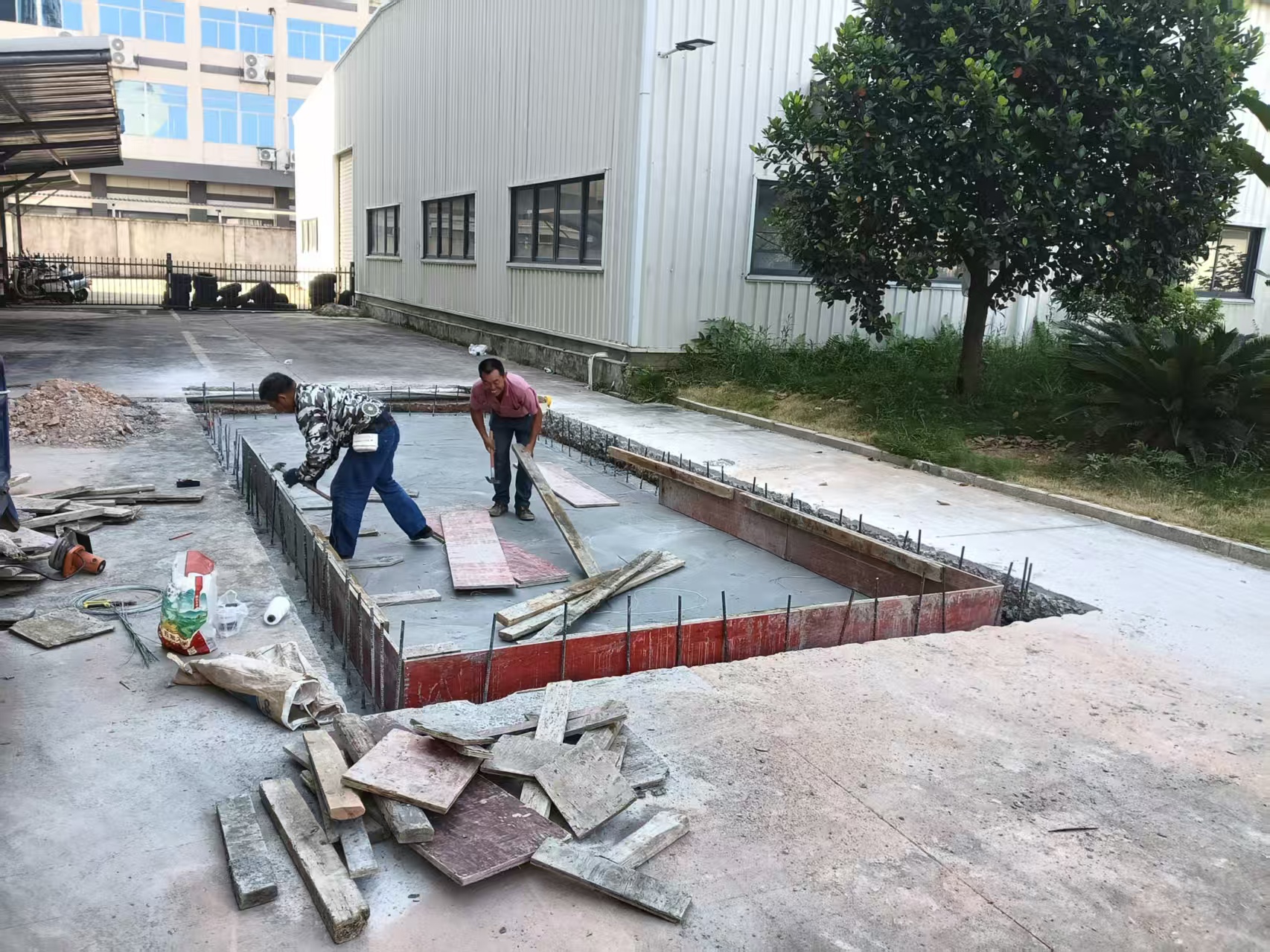
Pier Foundations: The Cost-Effective Default
Pier foundations use isolated concrete piers under each load-bearing point instead of one continuous slab. Less material, shorter build time, and generally the most cost-effective option on the table.
Shallow piers work fine in warmer climates with well-compacted soil. In colder regions, you need deep piers that extend below the local frost line — skip that, and freeze-thaw cycles will crack and heave the foundation within a few winters. On northern projects, pier depth should come straight from local frost-depth data, not an estimate.
Pier foundations are also more sensitive to soil quality than the other two options. Loose or high-moisture soil leads to uneven settlement, which tilts the deck over time and quietly erodes measurement accuracy before anyone notices a visible problem. So piers make sense when the budget and timeline are tight and the soil genuinely checks out — but that verification should come from an actual geotechnical survey, not a guess.
Floating Slab (Beam-Slab) Foundations: The Balanced Option
A floating slab, or beam-slab, foundation is a continuous reinforced concrete slab poured across the full length of the weighbridge, typically with integral beams for added stiffness. Load distribution is far more even than with piers, which largely eliminates localized settlement issues.
This design requires moderate soil bearing capacity — roughly 1,500 psf, though the exact figure depends on local codes and site-specific geotechnical data. It costs more than a pier foundation but delivers noticeably better overall stability, making it a solid middle ground between cost and long-term performance.
We typically recommend this option for higher-throughput sites — logistics yards, aggregate operations, anywhere trucks are crossing the scale constantly. Downtime for foundation repairs on a busy site is expensive in ways that go beyond the repair bill itself, so the extra upfront cost tends to pay for itself.
Pit (In-Ground) Foundations: Low Profile, Highest Cost
A pit foundation keeps the weighbridge deck flush with the surrounding ground, with an excavated concrete pit — commonly 2 to 6 feet deep — housing the load cells and providing maintenance access.
The main advantage is the low profile: no ramp for trucks to climb, which is valuable on space-constrained sites or anywhere the scale needs to blend seamlessly with the surrounding roadway, like inside a plant yard. The trade-off is scope — more excavation, more concrete, more labor — making this the most expensive of the three. Drainage is also non-negotiable here; standing water in the pit accelerates corrosion on load cells and structural components, quietly shortening the system's lifespan if it isn't managed properly.
What Actually Drives the Decision
Beyond budget, foundation selection comes down to a handful of concrete factors:
1. Frost depth– Critical in colder regions; underestimating it means dealing with heave damage within a couple of winters.
2. Drainage– Especially important for pit foundations, where standing water is a long-term structural risk, not a minor issue.
3. Soil bearing capacity– Get a real geotechnical survey rather than relying on assumptions.
4. Site slope– Sloped sites need extra design attention for leveling and drainage direction.
5. Long-term maintenance access– How easily technicians can reach the load cells later affects both lifespan and ongoing cost.
Foundations are invisible once the job is finished, but they're also the part that punishes shortcuts the hardest. Anything skipped during design or construction tends to resurface later as settlement, binding, or drift — and by then, the fix usually costs several times more than doing it right the first time would have.
At Fujian Fangda Weighbridge, every project starts with an actual site survey before any drawings are finalized. We don't run one template across different soils, climates, and usage patterns — the foundation plan should reflect the site, not the other way around.
If you're speccing a new installation or your current scale is already showing signs of settling or binding, happy to talk through the specifics. More often than not, the issue is a mix of foundation selection and construction execution, and separating the two is usually the first step toward actually fixing it.
英文表单
NAME :*
TEL :*
E-MAIL*
Describe the requirements:*


