
How Logistics Parks Use Smart Weighing Systems to Cut Costs?
Ask a logistics park manager what weighing costs them and they’ll usually quote the price of the scale — the hardware, the installation, the calibration. That’s the smallest number in the picture. The real cost sits in the minutes trucks spend waiting, the people who stand at the scale house, the disputes that take an afternoon to settle, and the data someone re-types at the end of the day. Walk through the gate at shift change and you can see it: trucks idling, drivers checking their watches, a clerk shuffling paperwork between lanes. Smart weighing doesn’t make the scale itself cheaper. It plugs those leaks. Here is where the money actually goes, and how each leak gets closed.
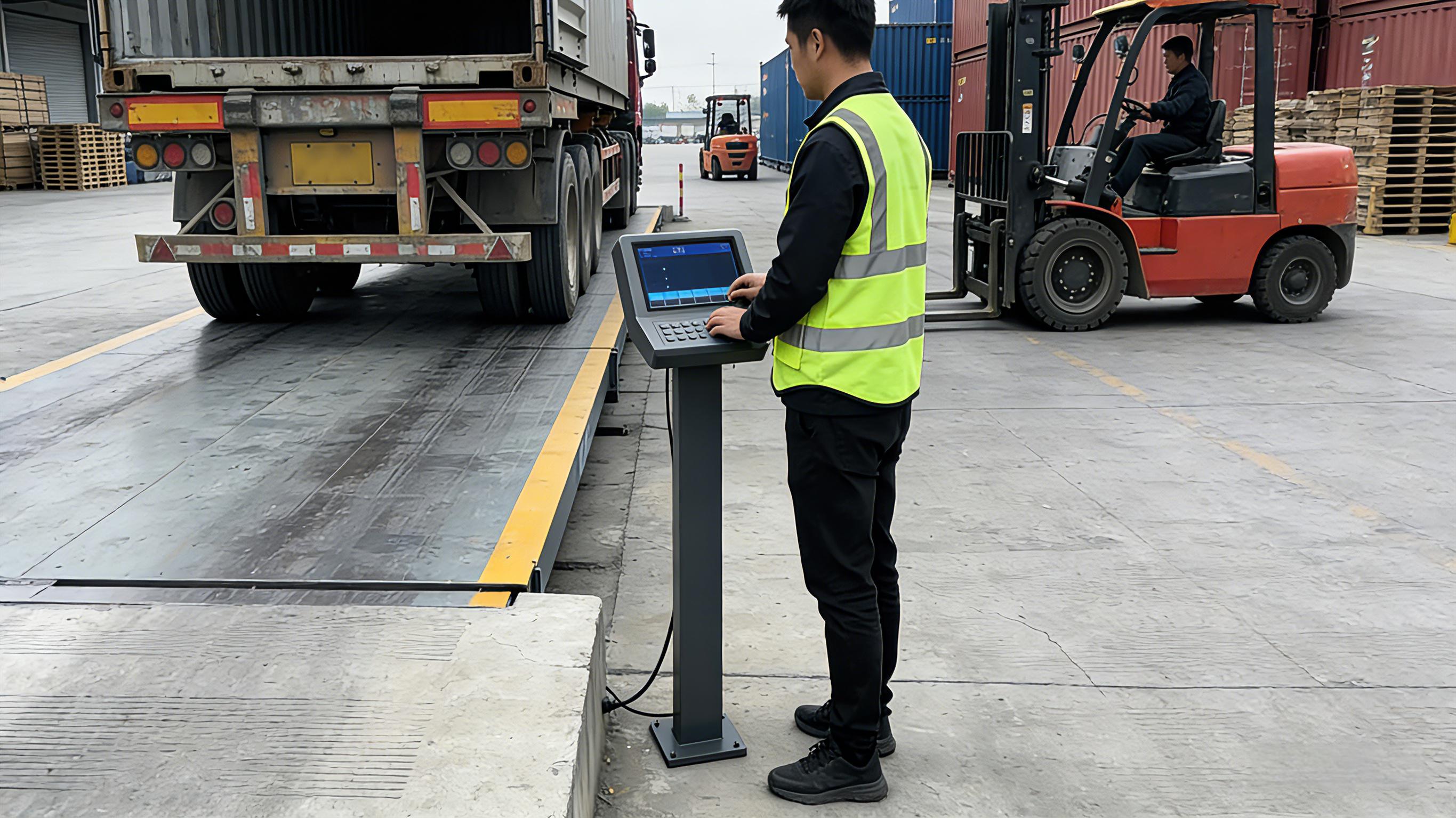
Leak 1: truck time spent waiting
Every minute a loaded truck idles at the gate is paid for by someone: the carrier, the tenant, or the park through goodwill and congestion. With manual weighing, each vehicle needs to be stopped, identified, weighed, and handed paperwork. You can almost hear the meter running while the driver waits for the okay to roll. With identification by RFID or plate recognition and automatic ticketing, that cycle shrinks considerably. In our experience a manual transaction commonly takes a few minutes, while an automated one can be completed in well under one.
You can estimate your own number without trusting anyone’s brochure. Multiply trucks per day by minutes saved per truck, then by what an idle truck costs you per hour. As a purely illustrative example, 200 trucks a day each saving 2.5 minutes adds up to roughly 500 minutes, or more than eight hours of truck time, recovered every day. Your figures will differ, which is why it’s worth calculating them. The point isn’t the exact number — it’s that the number is bigger than most people expect.
Leak 2: labor at the scale house
A manned weighbridge needs an operator for every operating hour, plus cover for breaks, leave, and night shifts. That’s a fixed cost that feels normal until you add it up over a year. Unattended operation removes most of that routine work, and the staff you keep can move to exceptions and customer service — the problems that actually need a human. The saving is largest on sites that run long hours, and smallest on sites that weigh only a handful of trucks a day, where a manned scale can still be the cheaper choice. Run the numbers for your own volume before assuming automation wins. Night shifts are often where the math gets interesting: a scale house that’s staffed around the clock for a trickle of trucks is an expensive habit.
Leak 3: disputes and manual errors
A handwritten log can be illegible, incomplete, or quietly adjusted. When weighing determines what a tenant pays or what a carrier is owed, even occasional disagreements consume management time and damage relationships. You’ve probably seen the scene: two people leaning over a clipboard, pointing at a number, neither willing to back down. Automatic records with a timestamp, vehicle identity, and weight, often with a photo, turn that argument into a lookup. The saving here is hard to see on a budget line because it hides inside hours of staff time and goodwill, but parks that handle many tenants tend to feel it first. Once the record is automatic, the conversation changes from “I think you wrote it down wrong” to “here’s the photo.”
Leak 4: overloaded vehicles
Overweight trucks cause fines, damage to internal roads, and rejected or re-handled loads. A system that checks weight at the gate, before the vehicle goes further into the site, lets you refuse or correct an overload at the cheapest moment, instead of discovering it later when the truck is already at the dock and the load has to be sorted out. Combined with records by vehicle and tenant, it also shows which operators overload repeatedly — which is useful information when it’s time to have a conversation.
Leak 5: re-entering data
If weights are written down at the scale and typed into another system later, you pay for the typing and for the mistakes it introduces. Someone at the end of the day, tired, copying numbers from a sheet into a spreadsheet — that’s where transposed digits and missed rows live. When the weighing system passes its data straight to your warehouse, billing, or logistics software, that step disappears, and reports that used to take days of reconciliation are available the same day. The person who used to do the typing can do something else.
Leak 6: unplanned downtime
A scale that fails without warning stops the gate. Trucks back up, phones start ringing, and someone is driving to the site to find out what’s wrong. Connected systems can report status remotely and flag trends such as a load cell drifting or a corner reading differently, so maintenance happens before a breakdown. For a park with several lanes or several sites, seeing them on one screen also saves the travel and phone calls it takes to find out what is happening. The goal is to fix the scale before it becomes the reason the gate is jammed.
What smart weighing does not fix
Three honest limits. First, accuracy still comes from the load cells and the platform. Software on top of a weak scale only produces wrong numbers faster and keeps better records of them. Second, there’s an upfront cost, so the payback depends on your volume and operating hours. Third, automation needs a plan for exceptions, such as an unrecognized vehicle or a sensor fault, with a way for a person to step in. A smart system that has no answer for the unusual case just creates a different kind of queue.
Where to start
You don’t have to automate everything at once. Many parks begin with vehicle identification and automatic ticketing on one lane, measure the time and labor difference, and extend from there. Before you spend anything, measure your current cycle time per truck, the hours of scale-house labor, and the number of disputes per month. Those three figures will tell you which leak is biggest. Start with the one that’s costing you the most, not the one that’s easiest to buy.
Who’s writing this
We’re Fujian Fangda Weighbridge, a truck scale and load cell manufacturer based in Fujian, China. We build weighbridge platforms and load cells together with identification, barrier, and software options for logistics parks, and we’re happy to help you size up your own numbers before recommending anything.
100-ton Weighbridge & Truck Scale
英文表单
NAME /COMPANY:*
TEL :*
E-MAIL*
Describe the requirements:*


