
Top Weighbridge Manufacturers and Suppliers in the Nigerian Market
Anyone who has sat in traffic near Apapa knows how much freight Nigeria moves by road. Containers leave the Lagos ports for factories and warehouses across the country. Cement, sugar, flour, and fertilizer travel out of industrial plants in tippers and trailers. Granite from quarries in Ogun, Edo, and Cross River feeds a construction sector that never seems to pause, and crude oil services, agro-processing, and the Dangote refinery complex add still more heavy traffic. All of it has to be weighed somewhere, and the quality of that weighing decides who gets paid correctly and who gets cheated.
Nigeria is therefore one of the most active weighbridge markets in Africa, and also one of the most demanding. Power supply is unreliable, humidity on the coast is relentless, trucks are routinely loaded beyond their rating, and spare parts can take weeks to arrive. Below is a look at who supplies weighbridges in Nigeria today, what to ask before you buy, and where Fujian Fangda fits.
Four Kinds of Supplier You Will Meet
Rather than a single dominant brand, the Nigerian market is split into groups that serve different needs.
Indigenous fabricators. Weighbridge & Scale Services Limited, incorporated in 2009 and based in Lagos, builds its own "Nigerian Magic" weighbridge in 15, 17.5, and 18 meter platforms rated from 60 to 100 tons. One of its documented installations was a 70-ton, 17.5-meter platform at the Snake Island free trade zone in Lagos, supplied to a multinational customer. For buyers who want a locally built scale and a nearby fabrication site, this is the kind of option to look at.
Lagos service and installation specialists. Kira Scales Limited, on Opebi Road in Ikeja, supplies and installs pit-type, surface-mounted, and portable weighbridges from 10 to 120 tons, plus extra-heavy 150-ton decks for quarries and ports, and handles calibration and breakdown support across Lagos State. The company states that it has completed more than 200 installations. Nentos Equipment Limited (Ikeja) and Rio-Weighing Systems Limited (Ikeja) are two further Lagos companies listed in business directories for weighing equipment sales and service.
Regional and nationwide providers. Mechatronix Group, based in Port Harcourt, describes itself as a government-approved supplier of weighbridges, industrial scales, and load cells with service coverage in Lagos, Abuja, and Port Harcourt. For buyers in the Niger Delta, where oil and gas, port, and construction activity concentrate, a supplier with local presence matters more than a nice brochure.
Direct imports from China. A growing share of new installations, especially for quarries, cement depots, mining sites, and agro-processors, comes straight from Chinese factories. The attraction is simple: heavier structural specification and faster delivery at a lower landed cost. The risk is just as clear: a poor choice of supplier can leave a buyer with a scale that rusts, drifts, or cannot be serviced. Fujian Fangda is one of the manufacturers active in this channel.
What Makes Nigerian Conditions Different
A weighbridge in Nigeria faces a handful of stresses that a scale in a temperate climate never sees.
Power. Grid supply is unreliable, so most sites run generators, and voltage spikes can kill a poorly protected indicator or load cell. Surge and lightning protection on the cabling and junction boxes is not optional.
Humidity and rain. Along the coast and across the south, constant moisture attacks steel decks, connectors, and sensor housings. A scale that looks fine at delivery can be badly corroded within a few seasons if the coating is thin.
Overloading. Trucks carrying aggregates, cement, and agricultural produce often run well above their rated payload. A scale built exactly to its nameplate capacity will fatigue early.
Distance from support. A quarry in Edo State or a mine in the north is a long way from a Lagos service engineer. Equipment that is simple to maintain and fix matters as much as features.
Where Fujian Fangda Fits
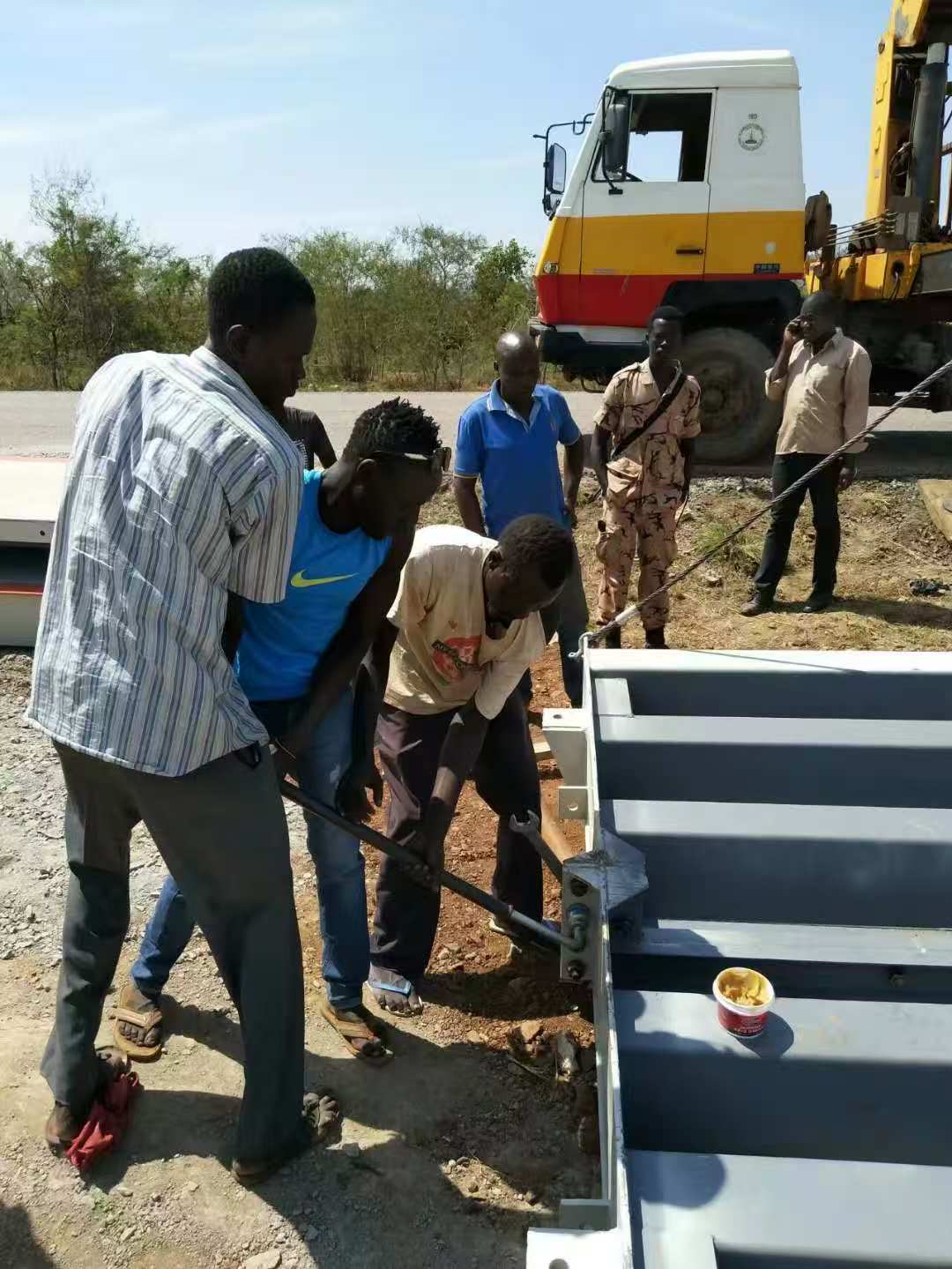
Fujian Fangda Weighing Equipment Co., Ltd., based in Xiangcheng District, Zhangzhou City, Fujian Province, designs and builds electronic truck scales, axle scales, and unattended weighbridge systems. The company controls the full production chain in its own factory: steel plate cutting, welded U-shaped main beams, sandblasting, multi-layer anti-corrosion coating, load cell calibration, and software integration. It exports to a range of markets in Africa and Asia, which has shaped how it thinks about tropical and heavy-duty use.
Matched against the Nigerian conditions above, a few points stand out:
Structural margin above rated capacity. Fangda builds with headroom over the advertised tonnage, which suits the overloaded reality of Nigerian haulage and extends deck life.
Coating built for humid climates. The sandblast-and-multi-layer coating process is aimed at exactly the moisture and salt-air exposure found around Lagos, Port Harcourt, and the Delta.
Robust electronics. Sealed junction boxes and protected cabling help scales survive generator-powered sites and electrical noise, though buyers should still plan on proper surge protection and earthing at installation.
Unattended weighing for busy gates. At ports, depots, and large plants, automated systems using plate recognition, infrared sensors, and cameras reduce queue times and limit the opportunities for ticket tampering that manual weighing stations are known for.
One factory for structure, sensors, and software. When something fails at a remote site, having a single manufacturer responsible for all three makes diagnosis and parts replacement simpler.
Questions to Ask Before You Order
· Is the structure rated for the loads you really carry, not just the nameplate figure?
· What is the coating specification, and how many layers, at what thickness?
· What surge and lightning protection comes with the system? Ask about it specifically.
· Who will install, calibrate, and certify the scale in Nigeria? Confirm that the paperwork meets local weights and measures requirements if the scale will be used for trade.
· How fast can a replacement load cell or indicator reach your site, in days or in months?
· What does the warranty cover, and is the manufacturer reachable after shipping?
Local Strength, Manufacturer Reach
Nigeria's weighbridge market will keep growing with its ports, industry, and construction. Indigenous builders and Lagos service companies offer proximity and familiarity, while Port Harcourt and Abuja providers extend that reach. Manufacturer-direct suppliers like Fujian Fangda offer another route for operators who need heavy-duty structure, humidity-ready construction, and automation at a competitive price.
The right choice depends on your site, your trucks, and how much support you can count on nearby. Whatever you decide, treat the weighbridge as a long-term piece of infrastructure rather than a one-off purchase, because in Nigeria's conditions the cheapest scale is rarely the one that costs the least over ten years.

英文表单
NAME /COMPANY:*
TEL :*
E-MAIL*
Describe the requirements:*


